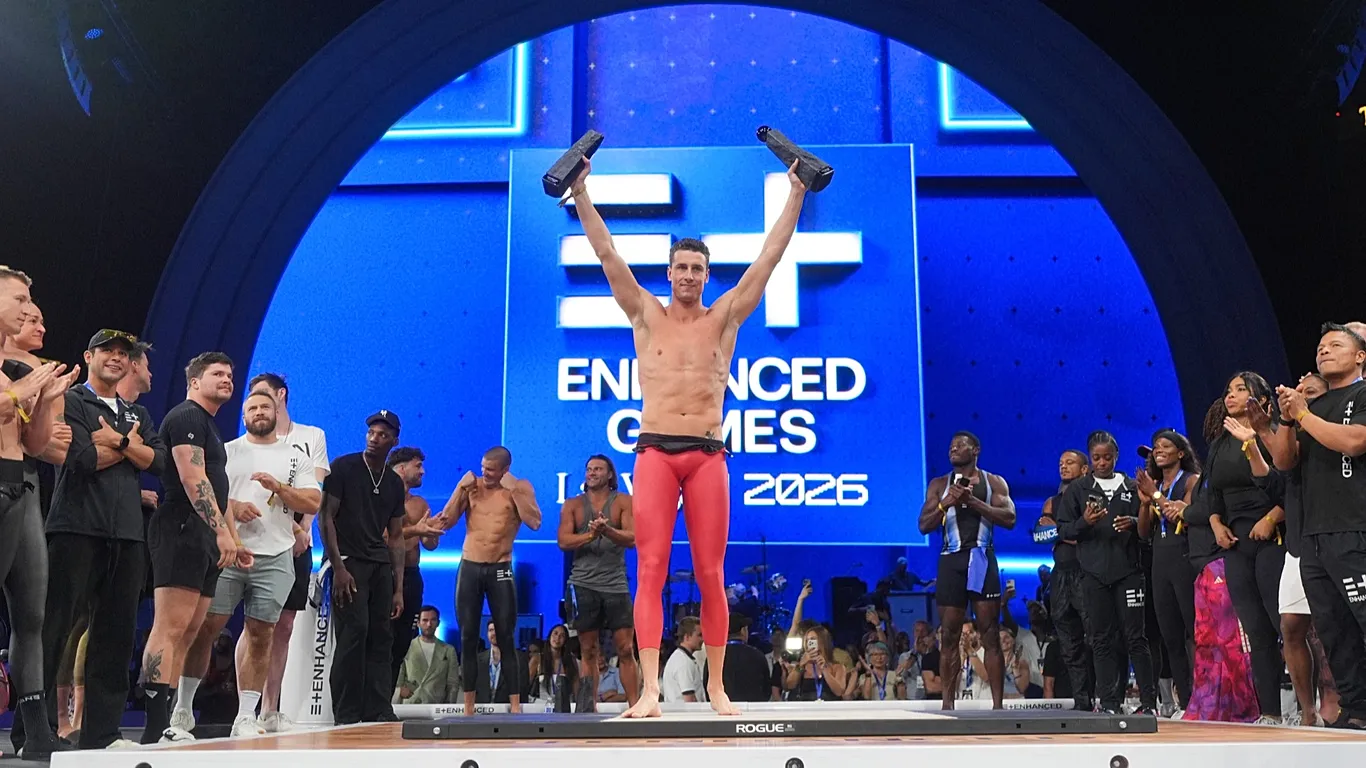
A $1million bounty on world records. Performance enhancing substances encouraged. 4 months paid and supported training. Consistent medical monitoring. Health checks and clearance before competing. £250,000 for a win.
Up to $25million was up for grabs for athletes at the Enhanced Games.
It seemed like the perfect recipe for records to topple like dominoes. However, the Enhanced Games, run by Enhanced Group marketing performance enhancing drugs to the consumer market, only broke one world record. And even that came in only 0.07 seconds under the official world record. Despite the use of performance enhancing drugs and a polyurethane swim suit.
In fact, three “unenhanced” athletes won in their categories, beating competitors who had been taking steroids and other performance enhancers: Hunter Armstrong took the win in the Men’s 100m backstroke; Tristan Evelyn won the women’s 100m sprint; and Fred Kerley the men’s 100m sprint.
Each of them takes home a $250,000 prize, but even last place on Sunday offered a $20,000 prize. Hunter Armstrong walked away from the Enhanced Games with $375,000 and said “I’d be lying if I said there was no backlash at all,” but added, “This was not a protest of any sort. I simply just wanted to come here, swim fast, win some money and not lose the opportunity to hear our national anthem at the Olympics, especially on home soil.”.
World Aquatics have introduced a bylaw that bans those who “support, endorse or participate in sporting events that embrace the use of scientific advancements or other practices that may include prohibited substances.” However, they’ve said they’ll consider individual athlete eligibility on a case by case basis, so there’s still a chance for Armstrong to compete.
The Enhanced Games has also been an opportunity for research. Many of the long-term effects of performance-enhancing substances are not well known, and athletes who have participated in the games will now be monitored for five years to better understand the effects. So far, data has already shown that out of the 34 doping athletes taking part in the trial, 91% used testosterone or related products, 79% took HGH, 62% opted for stimulants like adderall and 42% of athletes had been using EPO (historically used by cyclists to boost endurance). Colombian swimmer Isabella Arcila raised a concern with the Enhanced Games that the drugs might impact her fertility, and they offered to freeze her eggs. She took the offer, the drugs and walked away with two 3rd place finishes and $150,000.
Ultimately, with only one world record broken, the Enhanced Games were much like James Magnussen: the 3-time Olympic medallist came in a disappointing last place in his final, having boasted “I’ll juice to the gills and I’ll break [the world record] in six months”. Though the Games promised much, they delivered very little.
So what are our main takeaways from the Enhanced Games?
Maybe hard work, talent and discipline are more important than a cocktail of performance-enhancing drugs and “super suit” race kit.
Rather than testing who is most optimised and who is most willing to push the biological risk, we could just stick with sport as it is, and celebrate athletes pushing the limits of what talent and discipline can do. Sport should be a test of human achievement, not a competition to see who can best engineer their body.
What about the cash?
The appeal of such substantial prize money is undeniable. Swimmer Ben Proud observed that it would take 13 years of winning World Championship titles to earn the equivalent of what the Enhanced Games offers for a single event victory.
While the competition has struggled to attract young, up-and-coming athletes, it has proven highly attractive to retired competitors and those nearing the end of their careers, many of whom may be willing to accept significant health risks in exchange for a life-changing financial reward.
Ultimately, this highlights a broader issue within sport: if organisations have the means to compensate athletes fairly, they should do so. In that respect, and particularly in light of Kirsty Coventry’s recent comments opposing payment for Olympic and Paralympic athletes, the Enhanced Games may have identified a genuine weakness in the current sporting model. While its methods are deeply controversial, its recognition that elite athletes deserve greater financial reward may be one area where it has a point.
Finally, and perhaps most importantly, I cannot help but question whether this investment is being directed to the right place.
Rather than spending vast sums researching performance-enhancing drugs that may carry significant long-term health risks for athletes—and using sport as a platform to market these substances to the wider public—could we not invest that money in research instead? Sport has enormous influence and reach. For female athletes specifically, it could be used to educate and empower women with evidence-based knowledge about their health, performance, and wellbeing, helping them better understand and get more from their bodies throughout every stage of life.
I know, I know… “there’s no money in women’s health.” But just let me dream about what it would look like if we could change that.
Imagine a women’s health company valued at $1.2billion, with $25million to spend on women’s health research. My hot take: we’d break more than one world record.
Only 6% of sports science research is done on women.
64% of sporty girls quit by the end of secondary school.
30% of women in the UK become less active or drop out of sports and physical activity during the menopause.
75% of women fail to meet recommended physical activity guidelines during pregnancy.
With the right investment we can create systems that allow women to flourish. And break records.
Frankly, female athletes are already consistently breaking records without proper investment, funding, or systems to support them. So perhaps if the Enhanced Games really wanted to break records, rather than just sell peptides and testosterone, they’d be investing in the athletes and the systems around them.
If you have any feedback, complaints or comments please email us at hello@thewell-hq.com
As a reminder, the content of the course belongs to The Well HQ. You have permission to access and use the content yourself or, if you are an organisation, for the number of users selected, but are not otherwise permitted to share such content with others, all in accordance with our Course Terms and Conditions.