Now that the hype has died down, the athletes are home and medals are proudly on the mantle piece (or stashed safely in the sock drawer) it’s time to reflect on one of the most exciting Winter Olympics yet.
BBC Sport’s Milano-Cortina Winter Olympics coverage attracted 83 million streams and a TV audience of 26 million, both up significantly from the 2022 Games. BBC Sport’s YouTube performance during the Winter Olympics also delivered record-breaking growth, with total views up 390%. Women made up a record 47% of athletes at these Winter Games, and NBC reported that women’s sports had more prime time coverage than their men’s counterparts, for the 6th Games in a row.
One of the most-watched moments of the games was Alyssa Liu’s exceptional gold in women’s figure skating, which was the #1 most popular event at the Winter Olympics. This was a medal that Alyssa won on her own terms, reconnecting with the joy of her sport after retiring in April 2022 having felt burnt out. After winning her medal, she said she came back to skating, but this time: “No one’s going to starve me or tell me what I can or can’t eat”. What’s more, the touching videos of her celebrating their shared podium finishes with Ami Nakai, the 17-year-old Japanese skater, illustrate the power of women’s sports to showcase women raising other women up. Her medals illustrate the power of prioritising mental health, enjoyment and feeling truly supported within your sporting environment.

Another iconic story for figure skating is that of Amber Glenn, who after a frustrating qualifying skate revealed: “I’m on my period right now, so it’s always really hard, especially when… you have to perform in front of the whole world. It’s scary, and it makes you extra emotional, and it’s hard. And you have to go be an athlete. It’s something that we don’t really talk about a lot for female athletes, and I think it should be a topic of discussion.” It’s exciting to see athletes willing to talk about periods, which have been a taboo topic for too long. Amber using this opportunity to highlight the importance of this discussion is yet another signal of the increasing openness around women’s health within sport.
We’ve also seen how age does not define success. Whether it’s Francesca Lollobrigida winning two Olympic Gold Medals at the age of 35, or Claudia Reigler cutting up the giant slalom, age 52 at her fifth Games, setting a new record for the oldest woman to compete. We’ve seen more mature athletes excelling at these games. It’s a reminder for us all that age does not define success, and although sport is a culture obsessed with youth and physiological peaks, with age comes experiences, technique and training years, creating a reliable expertise that delivers results.
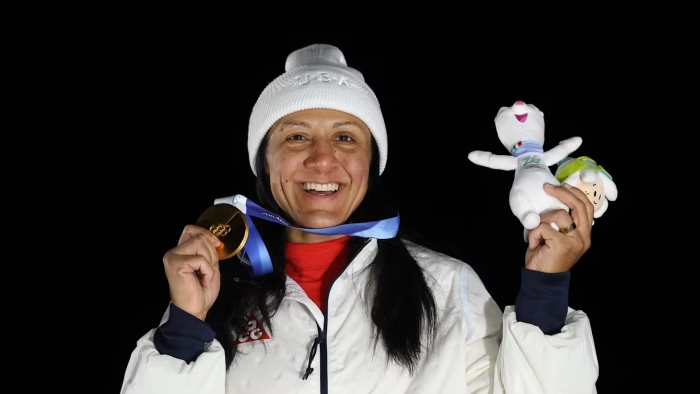
Similarly motherhood is no longer the block it once was to women’s athletic careers. Bobsledder Elana Meyers Taylor took her first Olympic Gold at age 41, becoming the most successful Black Winter Olympian in history, and touchingly signed to her deaf children “I love you” after each run. Before her race she said “They’re my biggest motivators to have them by my side and to see me day in and day out doing what I’m doing. It’s just the coolest experience.”
It was a year of iconic firsts for female athletes too, Regina Martínez Lorenzo made history as the first Mexican woman to compete in cross-country skiing at the Winter Games, a doctor who took up dog walking to fund her Olympic dream. 17-year-old Alpine skier Tallulah Proulx made history as the first female athlete to represent the Philippines at the Winter Olympics. Although being first comes with a gold medal, being the first reminds us we can still push the boundaries of what can be accomplished, even on the biggest sporting stage in the world.
From the first Olympics, to the last Olympics, who could forget Lindsey Vonn’s inspiring comeback and terrifying crash? Making the informed choice with her team to compete despite tearing her ACL just 9 days before the start of the Games, the 41 year old skier had been fast in practice but crashed out on her final Olympic run sustaining a serious injury. We couldn’t put it any better than Lindsey: “I hope if you take away anything from my journey it’s that you all have the courage to dare greatly. Life is too short not to take chances on yourself. Because the only failure in life is not trying.”
Eileen Gu also provided us with an important reminder, sometimes all you can do is laugh. When a male reporter asked “Do you see it as two silvers gained or two golds lost?”, she simply laughed in his face, and then asserted that she was the most decorated female free skier in history and every Olympic medal was a life changing experience for any athlete. In a world where women are often taught to downplay their achievements, coverage regularly focuses on female athletes appearance or romantic relationships rather than power or skill; and data shows that nearly two thirds of female athletes experience sexism in sport, Eileen’s response is a reminder to us all that sometimes the best thing you can do to sexism is laugh, and point out how ridiculous it is.
The Winter Olympics was not all celebration. It started with a campaign for equality for the female nordic combined athletes, followed by the removal of Gabriella Papadakis from commentary due to a legal row about her book addressing power imbalance and abuse in the figure skating world, and finished with a video emerging of the USA men’s hockey locker room. All of these remind us that the progress we have seen in women’s sports is not a given, it is as hard fought and hard won as every gold medal. Whilst the tide of women’s sports rises, lifting diverse and exceptional female athletes, there are groups that continue to fail to take women’s sports and women’s safety seriously. There is much work to continue to do.
The whole Olympic Games is an opportunity to cheer louder and applause longer for the athletes who have had barriers put in their way and have still risen to the challenge, persevering and pushing through to achieve their dreams. And yet again it’s a reminder that nothing is a done deal for women’s sports, and if we want to see change we still need to keep pushing forwards for more inclusive and supportive spaces that allow women to turn up wholly as themselves, and thrive.
What’s next? Well, we just can’t wait for the Milano-Cortina Paralympics to start!
If you have any feedback, complaints or comments please email us at hello@thewell-hq.com
As a reminder, the content of the course belongs to The Well HQ. You have permission to access and use the content yourself or, if you are an organisation, for the number of users selected, but are not otherwise permitted to share such content with others, all in accordance with our Course Terms and Conditions.